Increase Productivity with the right Breathing Practice
How to use breathing practice to regulate nervous system & increase productivity
“In average, an adult breaths 23,000 times a day. By the time you reach 30, you will have inhaled and exhaled roughly 250 million times.” — Beyond the 9 to 5, BBC
That’s a lot of breaths, but how often do you actually aware of the way you’re breathing?
Quick, shallow breaths are the stem of inducing stress and anxiety, the last thing you need in your already busy and demanding modern life.
More and more major corporations are adopting breathwork and breathing techniques routine for their staff. The aim is to help them focus their minds so that they can improve the quality of their works.
Our nervous system is the embodiment of our mind. When we’re stressed or anxious, the brain sends signals to the nervous system to either fight, flight or freeze. This is known as the stress response.
What happens when we’re constantly in the stress response mode?
 Not only that we would accumulate all sorts of health problems, such as high blood pressure, depression and chronic pain, to name a few, but the mind that’s stressed will not be able to produce great results in whatever task it’s assigned to do.
The breathing techniques we know today actually have been inspired by the ancient Pranayama* breathing practice, a yoga practice that goes back over 4,000 years ago.
This is a practice in which to attempt the control of the breath by lengthening and/or directing it in certain way. The intention is to trigger the parasympathetic nervous system, the resting and relaxing response.
When the calming nervous system is activated, it slows down the heart rate, decreases blood pressure and releases the ‘feel-good’ hormone called endorphins. This hormone helps to clear the ‘fog’ in the mind to boost clarity and focus.
But this is not a quick fix, breathing technique has to be practiced consistently and regularly for it to take effect. A daily practice, 4 to 5 times a week would be recommended adding whenever time allowed and applicable throughout the day or week.
So here’s your challenge, should you choose:
Try the following these breathing practices, do this every week. Keep it lightly and don’t think of it as a task. Resolve in your mind that it’s only going to take a few minutes of your time.
If you keep a weekly journal or calendar, jot down a few words to describe how you feel or experience in the practice. If nothing is experienced then all is good.
Don’t forget to enjoy the process!

Breathing Practice 1:
Take 10 long and slow breaths at the beginning of either a meeting, a briefing, or a brainstorming session. It’s particularly great to do when you’re required to involve your creative mind.
>> Instructions <<
Ideally, everyone will have been seated. Sitting relax on the chair but the spine is upright, both feet planted firmly on the floor. Lower gaze down, or softly close the eyes. Hands resting comfortably on the lap, shoulders relax. Take 10 long deep breaths, slowly, and see if you can deliberately extend each exhalation. You can also put a timer on for 2 minutes if you tend to lose count of the breath.
>> Fun tips <<
You can call this the Two-Minute-Breathing to cue your staff to prepare themselves for this practice at the beginning of your meetings.
Breathing Practice 2:
When you’re going to bed before you fall asleep. This is excellent to help with insomnia, late sleep onset and restless sleep. Lack of sleep reduces productivity because nothing creative can come out of a tired brain.
>> Instructions <<
Lie comfortably on your bed and check that your spine is straight. Make sure your pillows aren’t either too high or too low. Place both hands on your abdomen, on or about your belly button, and breath naturally for a few moments.
Now paying attention to your abdomen area, where your hands are, and see if you can gently direct your breath towards this area. So instead of the ribcage flaring out and in, see if you can get your abdomen expanding and contracting with the breath. Do not force anything, simply direct the breath down towards your belly.
You can do this for 10 breaths or 2 minutes, gradually over time you extend the time 3 to 5 minutes.
>> Fun tips <<
When you’re waiting in the queue you can apply this breathing technique. Simply place one hand on around your belly button and direct your breath down to this area. Be mindful that the chest doesn’t get involved too much as it tends to happen when you are in upright position.
*Yoga and Pranayama are not a religion practice. These are ancient traditions that predate the formulation of what would be defined as a religion.
Intan Ridwan, 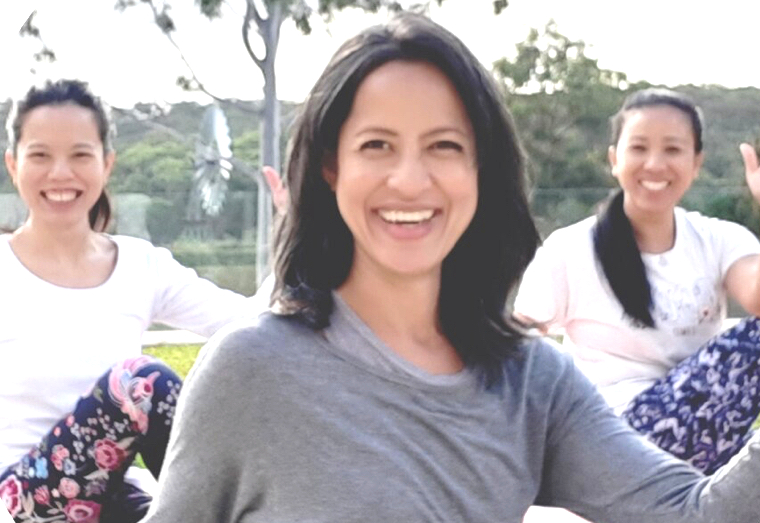 www.beginnowyoga.com
Originally from Jakarta, Intan is a Sydney-based yoga, pranayama and meditation teacher, teaching both face-to-face and online classes.
She has 17 years of corporate background in multinational companies and found yoga helped tremendously in navigating a busy working life as well as raising children and keeping a family together.
She’s dedicated to providing yoga practices that work and accessible for everyday people. In her spare time, you can find her outside soaking up some sunlight with her tuxedo cat, and ideally with a book in hand.